
Built and fitted by certified automotive locksmiths ALOA CMAL NASTF VSP
FR514-422-0303
by Autokey Book an install
Français Killpin Stealth Killpin Code How it works About Service area Contact Book an install
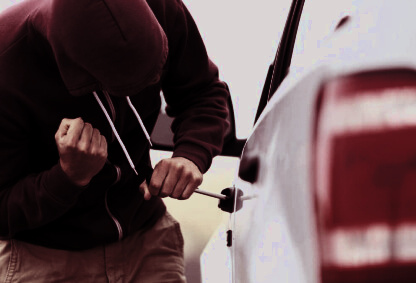
A figure forcing a car door
Killpin  /  How it works
Explained plainly

How car theft actually works now — and where Killpin sits.

No jargon and no scare statistics. This is what's genuinely happening to vehicles in Montreal, why the security your car came with doesn't stop it, and what an immobilizer changes about the arithmetic.

Start here

Your car doesn't check who you are. It checks what you're holding.

Every factory anti-theft system rests on a single assumption: that whoever presents a valid key must be the owner. It was a reasonable assumption when copying a key meant a locksmith and a blank. It isn't one now.

Modern theft doesn't attack the lock. It manufactures a key the car will accept — and then the car cooperates fully, because as far as it's concerned, you've arrived.

The three methods

What we actually see.

01

Relay attack

Your fob is always transmitting a short-range signal. Two people with radio equipment extend that range: one stands near your house capturing the signal through a wall or door, the other stands at the car and repeats it. The car senses the key nearby and unlocks and starts. No glass broken, no alarm, roughly a minute's work.

02

Key cloning via the diagnostic port

The port under your dashboard exists so a garage can talk to your car. Tools that use it are sold openly. With physical access, a new key can be written directly to the vehicle in minutes. The result isn't a fake key — it's a real one, which the car will keep accepting long after the theft.

03

Module swap

Where a manufacturer has hardened key programming, the workaround is to replace the module enforcing it with a pre-programmed one. It's more work and it leaves traces, but it's well within the reach of an organised crew, and the factory immobilizer is ultimately a part that can be unbolted.

These aren't hypotheticals from a security conference. They're the methods behind the cars actually going missing here — and lawful versions of all three are day-to-day work in our shop.

Jerry Arnstein — ALOA CMAL, first in North America
The common thread

All three end with a key the car trusts.

That's the useful insight, and it's what Killpin is built on. If every route into your vehicle finishes with a valid key, then adding more key security just raises the cost of producing one — it doesn't change the outcome.

So Killpin doesn't defend the key at all. It puts a second, separate condition on the engine: a code that exists only in your head and in a module hidden in your car. Nothing a thief can carry in, plug in or transmit will produce it.

Killpin Stealth

Holds the engine until you enter a sequence on the vehicle's own buttons. Nothing whatsoever is added to the cabin.

Killpin Code

Holds the starting circuit until a PIN is entered on a hidden illuminated keypad. Reaches vehicles that Stealth can't.

Closed to remote attacks

Every convenience is a door.

Remote access is the easiest way into most vehicle security — which is exactly why Killpin doesn't offer one. Adding it would build in the weakness the product exists to remove.

A phone can be taken, unlocked or cloned. An account can be phished. A server can be breached. A wireless signal can be captured and replayed — which, as it happens, is method one on this page. An immobilizer that can be reached from outside the car is an immobilizer with a remote attack surface, however well it's implemented.

  • No smartphone app
  • No Bluetooth pairing
  • No extra fob to carry or clone
  • No cloud account holding your code
  • No remote disarm — not even for us

If you forget your code there's a documented procedure, carried out in person on the vehicle. Deliberately not something that can be done down a phone line.

The moment it matters

What somebody trying it actually runs into.

Everything above describes how a thief gets as far as a working key. This is what happens next — and it is the entire reason the device exists.

01

They get in, and nothing changes.

Killpin is not a door lock and doesn't pretend to be. Relay the fob, clone a key, plug a tool into the port under the dash — every one of those still works exactly as well as it did. So far they are having a completely ordinary evening.

02

They go to start it. It doesn't.

Here is where the evening stops being ordinary. The key is valid, the car accepts it, and the engine still will not run — because the one thing it is waiting for was never in the vehicle to begin with. It's in your head.

03

There is nothing to look for.

No keypad on the dash, no blinking light, no second fob on the ring to explain what just went wrong. Nothing announces itself, and there is no standard place to start pulling trim apart hunting for it.

04

Time runs out before they do.

A theft meant to take under a minute has become an open-ended problem in somebody else's driveway, in the dark, with no idea how long it will take. That is the calculation Killpin changes, and it is usually the only one that matters.

Find out which Killpin fits your car.

Send us the year, make and model. We'll tell you what we can fit, what it involves and what it costs — before you commit to anything.

Book an install 514-422-0303